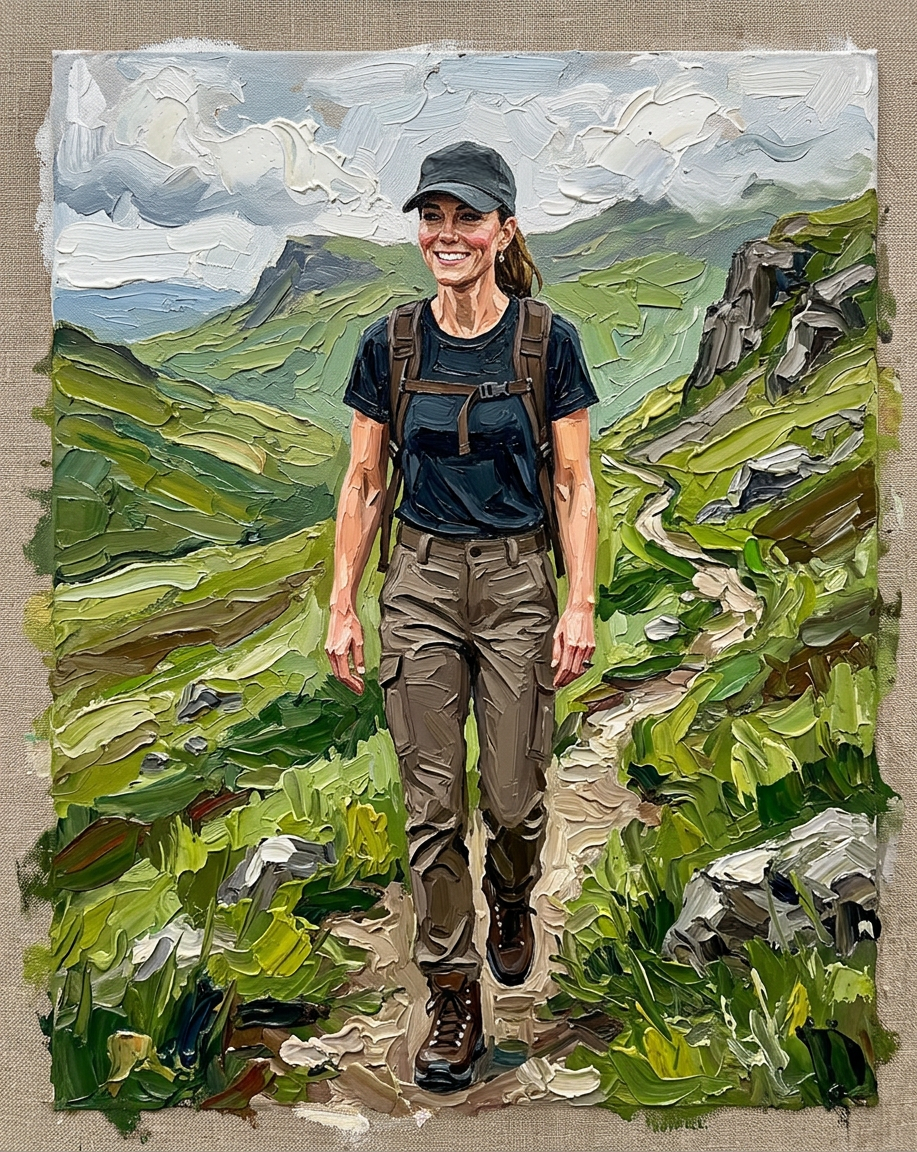
There is a photograph from the weekend of 27 June 2026 that says more than most royal portraits manage in a career. Catherine, Princess of Wales, stands somewhere on a hillside covered in fog, smiling. She is 23 miles into one of Britain’s toughest endurance challenges, the rain is coming in sideways, and she looks, there is no other word for it, glad to be there.
That photograph is the whole story, really. But it is worth telling properly.
Over the course of that weekend, Catherine climbed the three highest mountains in the United Kingdom (Ben Nevis in Scotland, Scafell Pike in England, and Yr Wyddfa in Wales), covering 23 miles and more than 10,000 feet of ascent, all within a single day. She did it alone, without the ceremonial scaffolding that surrounds most royal engagements, and she did it to raise money for The Royal Marsden Cancer Charity, the London hospital where she received her own cancer treatment. Kensington Palace confirmed the completion on 28 June.
The personal context is not incidental to the story. It is the story. In 2024, Catherine revealed that she had been diagnosed with cancer and was undergoing preventative chemotherapy. In January 2025, she announced she was in remission. She has been gradually resuming public life since, overseas visits, charity engagements, Trooping the Colour, Royal Ascot, each appearance watched with a particular kind of collective attention that has very little to do with protocol and rather a lot to do with how much people have found themselves caring about her recovery.
The National Three Peaks Challenge was something different from all of those. It was not a state occasion. It was not a carefully managed public appearance. It was a woman deciding, privately and then publicly, that she was strong enough to climb three mountains and wanted to do something with that strength. Her own words, recorded in a video during the climb, were characteristically quiet about it: “I’m so grateful to be here, to be strong enough to walk these hills.” She said she wanted to give something back, and to support the work of the Royal Marsden, which she described as “very dear to me.”
What I keep returning to, thinking about that weekend, is a moment on Ben Nevis that had nothing to do with the challenge itself. High on Britain’s highest summit, Catherine stopped to speak with a boy of eleven named Ted Haslam, who had reached the peak in his wheelchair, accompanied by his father and a team of family and friends, all raising money for Molly Ollys, a charity supporting children with illnesses that threaten their lives. She asked whether he was warm enough. She asked whether he had a mascot on his wheelchair. She stood with him, on a mountain, in the cold, and was simply interested in him. That is not something you perform. That is something you either are or you are not.
At the finish line, Prince William was waiting. So were their three children, George, Charlotte, and Louis. So were her parents, Carole and Michael Middleton, and her brother James. The photograph from that reunion, her smile described by everyone who saw it as uncomplicated joy, became one of the most shared royal images of the year.
In her personal statement, Catherine wrote that cancer does not simply affect the body. “It changes how you think and feel and profoundly affects every aspect of life,” she wrote. “The journey through and beyond treatment requires more than medicine alone.” The Three Peaks Challenge was her own answer to that observation, worked out in miles and elevation and cold mountain air rather than words.
The Royal Marsden Cancer Charity will be better funded for it. That matters on its own terms. But what the weekend also quietly demonstrated is something harder to quantify: that there are ways of showing up that have nothing to do with a schedule of engagements, and everything to do with what a person decides to do with the life they have been given back.
I keep thinking about that boy on Ben Nevis, and the fact that she stopped.
Charlotte Ashby is Crown & Court’s Culture and Lifestyle Correspondent. A country house enthusiast and lifelong royal devotee, she writes about how royals actually live: the homes, the rituals, the family moments that rarely make headlines.
“Behind every crown is a family. And families are always interesting.”