Crown Chronicles: history that still shapes the throne.
The medical records of George III run to more than one hundred volumes. Historians and physicians have been arguing about what those records prove for the better part of three centuries, and they have not yet reached agreement. What they do agree on is considerably more interesting than any diagnosis: that a British monarch’s illness, beginning in October 1788, brought the constitution of the United Kingdom to the edge of a crisis it had never formally prepared for.
George III came to the throne in 1760, aged twenty-two, and for the first quarter-century of his reign gave no serious indication that any of this was coming. He was known for his domestic virtues — more farmer than monarch, in the affectionate public characterisation — and his interest in science, farming, and music. He lost the American colonies and gained, arguably, the war against Napoleonic France. His reign, long and in many ways consequential, is still primarily remembered for something that happened to him rather than anything he chose to do.
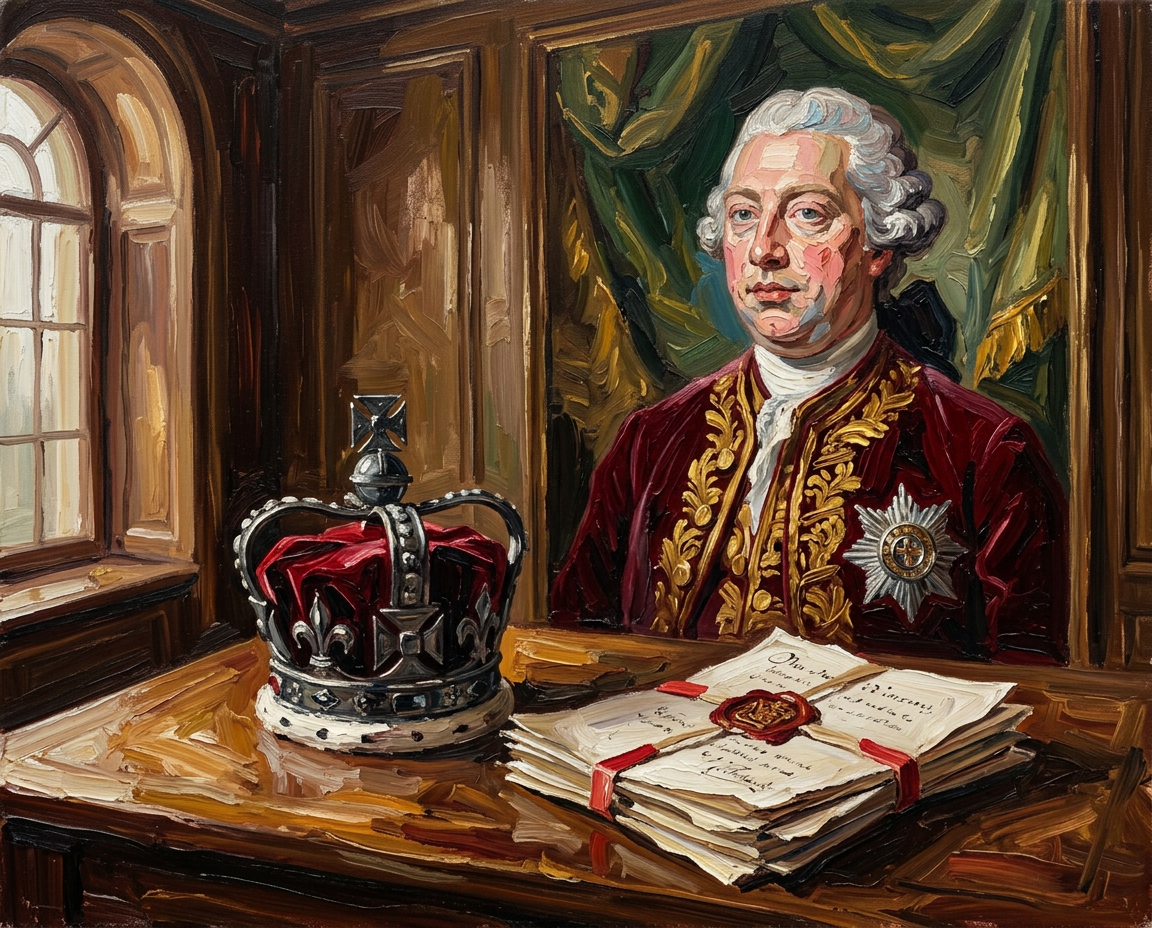
The first major episode began in October 1788. The king’s physicians recorded a catalogue of physical symptoms: abdominal pain, racing pulse, muscular weakness, fever, and — the detail that was later to generate enormous diagnostic controversy — urine described as dark in colour. His mental state deteriorated at the same time. Contemporary accounts describe a man speaking without stopping for hours, incapable of coherent direction, occasionally violent. Prime Minister William Pitt received word from Windsor by express letter that the king’s disorder had taken “so serious a turn” that his life might be in immediate danger. Parliament could not formally open. The business of government had lost its head.
What followed was less a constitutional solution than a constitutional argument, which is the condition in which the British constitution tends to spend most of its time. Pitt, who was the king’s own minister, argued that it was Parliament’s right to appoint a regent and to define what powers that regent would hold. Charles James Fox, leader of the Whig opposition and a personal ally of the Prince of Wales, argued the opposite: that the Prince had an absolute, inherent right to assume full royal powers without Parliamentary conditions. The difference between these positions was not merely philosophical. Pitt knew that the Prince would remove him from office if given unrestricted authority. Fox knew the same thing, which was why he argued so strenuously for the Prince’s natural right.
The Regency Bill passed the House of Commons in February 1789. Before the House of Lords could vote on it, the king recovered. No formal regency was established — a resolution the constitution had not produced so much as stumbled into.
He was not well for long. Further episodes followed in 1801 and 1804, each handled with varying degrees of political anxiety. The final breakdown came in November 1810, following the death of his youngest and most beloved daughter, Princess Amelia. George III was seventy-two. He never recovered. Parliament formally established the Regency in 1811, and the Prince of Wales — the future George IV — governed in his father’s name for nine years, until the old king died at Windsor in 1820, deaf and blind and quite alone.
The question of what actually afflicted him has generated more medical literature than almost any other royal illness in history. The porphyria hypothesis, advanced by a mother-and-son team of psychiatrists in the 1960s, gained considerable popular traction and eventually a film and a stage play — though recent medical historians have challenged it vigorously, noting that the original researchers were selective in what evidence they used. Analysis of the king’s letters has suggested features consistent with the manic phase of bipolar disorder. Examination of a sample of his hair in 2005 revealed arsenic levels more than two hundred times the toxic threshold, possibly introduced by one of his medications. The most intellectually honest position, which historians are rarely thanked for taking, is that we do not know precisely what happened to the mind of George III, and perhaps never will.
For readers who want the longest and most considered account of this king’s full history, including the illness, the politics, and the surprisingly rich domestic life, Christopher Hibbert’s George III: A Personal History remains the most detailed single volume in English, and the one against which other accounts are measured.
What the Regency crisis of 1788 demonstrated, beyond any specific diagnosis, is that constitutional monarchies of the eighteenth century had no established procedure for the incapacity of the sovereign. The question of what a king became when he could no longer be king was one the British constitution had managed, rather impressively, to avoid answering — and nearly paid for that avoidance in 1788. It did not pay for it then. The answer, when it was finally formalised in 1811, was both simple and insufficient: Parliament would decide.
Edmund Calloway is Crown & Court’s Royal History Correspondent. A retired Oxford professor with thirty years studying European dynastic history, he believes the present makes considerably more sense once one has properly understood the past.
“History doesn’t repeat itself — but dynasties certainly do.”