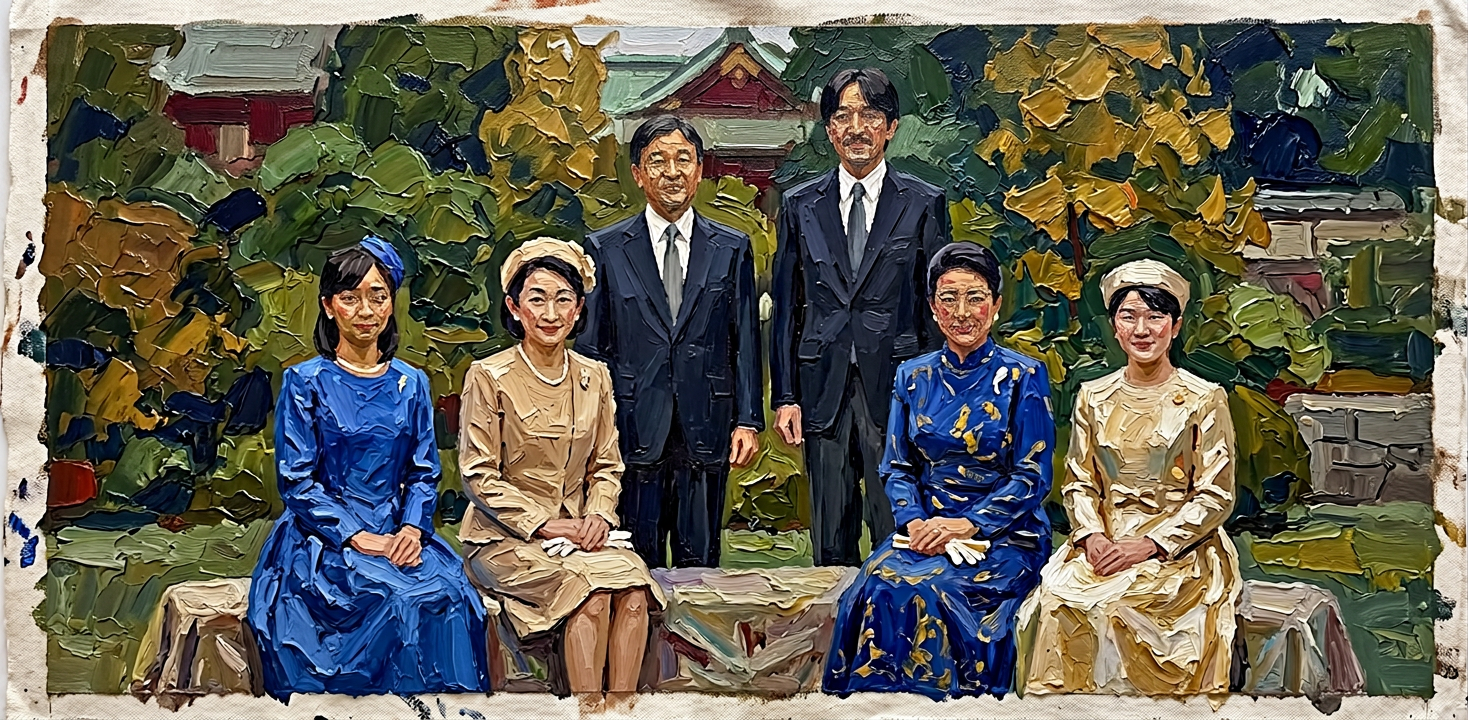
The Chrysanthemum Throne is one of the oldest royal institutions on earth. It also has three male heirs, thirteen women who cannot inherit, and a parliament that has spent decades avoiding the obvious conversation.
When I lived in Copenhagen, I came to understand something about monarchy that Tokyo had not yet taught me: that the institutions which endure are not the ones that refuse to change. They are the ones that change just enough, just in time, to make change feel unnecessary.
Japan has not yet learned this. It is running out of time to do so.
The Imperial House of Japan is, by most accounts, the oldest continuous royal institution in the world — its lineage, in tradition if not in verified historical record, stretching back more than 2,600 years to the sun goddess Amaterasu. It is an institution of extraordinary cultural weight, deeply woven into Japanese identity, Shinto practice, and the country’s sense of itself as a nation apart. And as of May 2026, it has three male heirs.
Three.
The line of succession to Emperor Naruhito, the 126th Emperor, runs as follows: his younger brother Crown Prince Akishino; Akishino’s son, eighteen-year-old Prince Hisahito; and the Emperor’s uncle, Prince Hitachi, who is in his late eighties. Beyond these three men, the succession stops. Not because there are no imperial family members — there are eighteen — but because thirteen of them are women, and under the Imperial Household Law of 1947, no woman may ascend the Chrysanthemum Throne.
The cultural context here is important, and my Western colleagues sometimes miss it. Japan is not a society that opposes female leadership in any simple or sweeping sense. Women lead corporations, universities, and — since early 2026 — the national government itself, with Prime Minister Sanae Takaichi holding office. Public opinion on the succession question has shifted considerably: a nationwide poll conducted by the Mainichi Shimbun in early 2026 found that 61 percent of respondents supported amending the Imperial House Law to allow women to succeed, with only 9 percent opposed. The resistance is not coming from the Japanese public. It is coming from within the conservative political establishment, where a segment of the ruling Liberal Democratic Party has long argued that male-line succession is not merely tradition but the defining characteristic of what makes the Japanese imperial institution uniquely, irreducibly Japanese.
That argument is becoming harder to sustain. Emperor Naruhito himself — who is constitutionally barred from making political statements — has spoken with notable care about the dwindling size of the imperial family and the consequences for its ability to perform public duties. His daughter, Princess Aiko, is twenty-four years old, university educated, and by all accounts deeply committed to her role. She is also, under current law, unable to inherit her father’s throne. If she were to marry a commoner, as her cousin Princess Mako did in 2021, she would lose her imperial status entirely.
I have spent time with people who follow the Japanese imperial family closely, and what strikes me most in their accounts is not the constitutional complexity but the human cost. The women of the imperial household live under constraints that would astonish most observers. They cannot speak freely in public. They cannot choose their own schedules. They cannot, in any meaningful sense, leave. And under current law, their only exit — marriage — costs them everything.
In April 2026, the Japanese parliament announced the formation of a dedicated committee to examine succession law and develop proposals for stable succession. It is progress, of a kind. The Scandinavian monarchies resolved their succession questions decades ago — Norway in 1990, Sweden in 1980 — by simply extending inheritance rights to daughters. The British Crown followed in 2013. Japan is watching these precedents from a considerable distance, and the political will to close that distance remains, at best, uncertain.
Prince Hisahito turned eighteen in 2024 and met the Japanese press in his first official capacity in March 2025, pledging to fulfil his royal duties. He is a young man carrying the full weight of an ancient institution’s future on his shoulders. That is, by any measure, a great deal to ask of anyone.
The Western press will cover this story when a crisis becomes impossible to ignore. I have been watching it for years already.
Nadia Osei-Mensah is Crown & Court’s International Royal Correspondent. Born in Accra, raised in Copenhagen, and educated in Tokyo, she is fluent in five languages and equally fluent in the customs and complexities of royal families from every corner of the globe.
“Every crown tells a different story. I’m here to translate.”