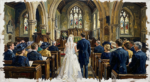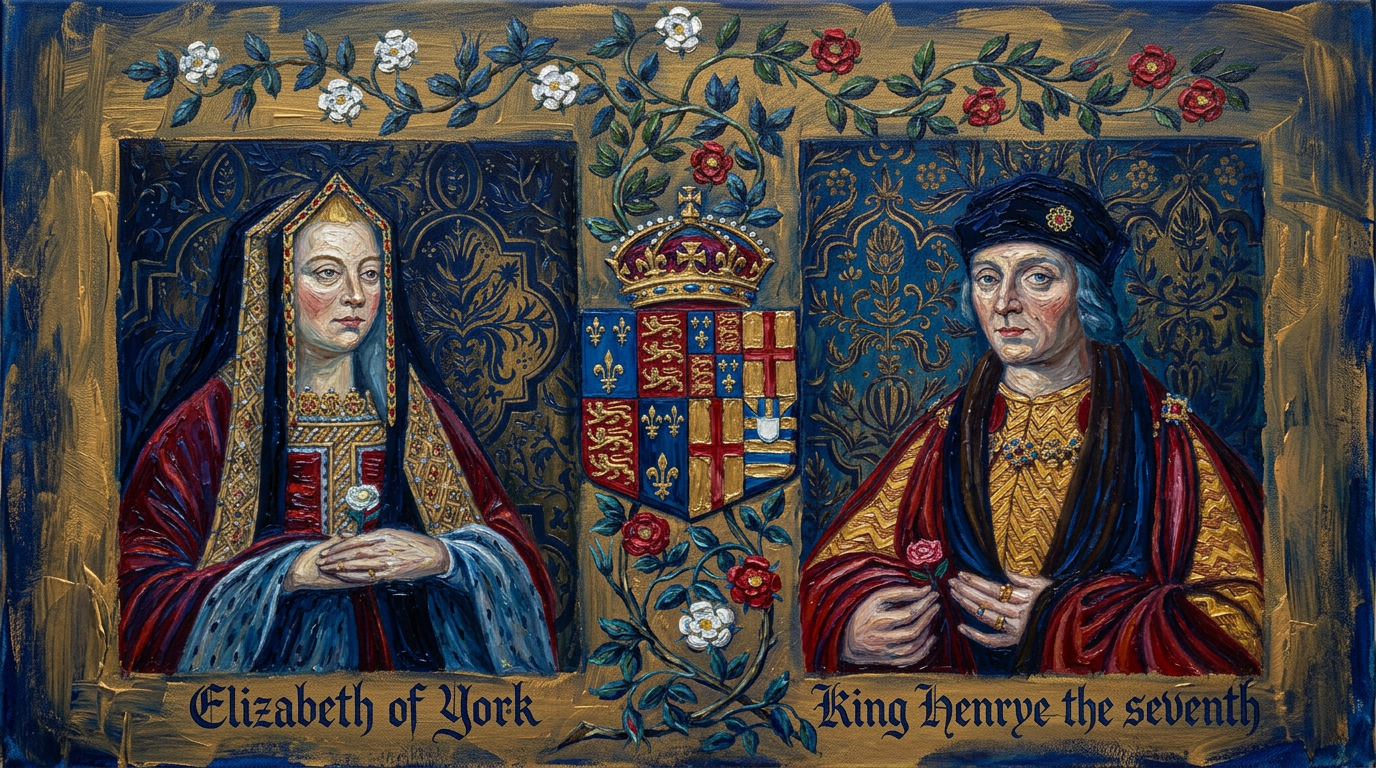
In January 1486, two young people who had never met stood at the altar of Westminster Abbey and, by the simple act of exchanging vows, ended thirty years of civil war. History rarely pivots so neatly. This time, it did.
There is a question I have put to every undergraduate who has ever sat in my tutorials at Oxford, usually in their first week, usually when they are still sufficiently intimidated to answer carefully.
The question is this: what is the most consequential royal marriage in British history?
They offer the expected answers. Henry VIII and Catherine of Aragon — the union that broke England from Rome. Victoria and Albert, the partnership that shaped an empire’s moral imagination. Charles and Diana; and here I stop them, because they are confusing consequence with coverage, which is a mistake historians cannot afford.
The correct answer, I tell them, is a wedding that most of them have never heard of. A ceremony at Westminster Abbey on the eighteenth of January, 1486, between a cautious, calculating Welshman named Henry Tudor and a quiet, intelligent young woman named Elizabeth of York.
That marriage did not merely join two people. It joined two dynasties that had been trying to destroy each other for thirty years. It ended the Wars of the Roses. It created the Tudor dynasty. And it set in motion a chain of events that would produce, within three generations, the English Reformation, the defeat of the Spanish Armada, and the foundations of the British Empire.
Not bad for a wedding.
The War Nobody Wanted to End
The Wars of the Roses — the name itself is a nineteenth century invention, almost certainly popularised by Sir Walter Scott rather than any medieval chronicler — were a series of civil conflicts fought between the House of Lancaster and the House of York for control of the English throne between approximately 1455 and 1485.
The details are labyrinthine, the cast of characters bewildering, and the body count considerable. Kings were made and unmade with alarming regularity. Henry VI, a Lancaster, lost his throne to Edward IV, a York; regained it briefly; then lost it again and was almost certainly murdered in the Tower of London in 1471. Edward IV died in 1483, his young son Edward V disappeared into the Tower alongside his brother Richard — the famous Princes in the Tower, whose fate remains one of history’s most debated mysteries — and his brother Richard III seized the crown.
It was Richard III whom Henry Tudor defeated at the Battle of Bosworth Field on the twenty-second of August, 1485. Henry was thirty-eight days short of his twenty-eighth birthday. He had spent most of his life in exile. He had never governed anything larger than a household. And he had just become King of England by killing the previous incumbent in a field in Leicestershire.
His position was, to put it diplomatically, precarious.
The Genius of the Union
Henry VII was not a romantic. Contemporary accounts describe him as careful, shrewd, and somewhat cold: a man who counted his coins and measured his words with equal precision. He did not marry Elizabeth of York because he loved her, though there is evidence suggesting genuine affection developed between them. He married her because she was the daughter of Edward IV, the granddaughter of Richard, Duke of York, and the living embodiment of Yorkist legitimacy.
Henry was Lancastrian by blood; tenuously so, through an illegitimate line that required considerable genealogical creativity to make convincing. Elizabeth was Yorkist by birth, directly and undeniably. Together they were both. Their children would be neither Lancaster nor York but Tudor — a new thing entirely, emerging from the wreckage of the old conflict.
The symbolism was deliberate and complete. The Lancastrian red rose and the Yorkist white rose were combined into the Tudor rose, red and white petals together; an image that remains one of the most recognisable royal symbols in the world today. You will find it carved into the stonework of Hampton Court Palace, embroidered into the vestments of Westminster Abbey, stamped onto the covers of passports issued by His Majesty’s Government. A marriage made five centuries ago is still present in the objects of daily British life.
The Woman History Underestimated
Elizabeth of York deserves considerably more attention than history has typically afforded her. She was twenty years old at her wedding, the eldest daughter of Edward IV and Elizabeth Woodville, and she had already survived more political turbulence than most people encounter in a lifetime. Her father had died when she was seventeen. Her brothers had vanished into the Tower. Her uncle had declared her illegitimate. She had been, at various points, a princess, a bastard, and a pawn.
She became, by most accounts, an exceptionally capable queen consort. She bore Henry seven children, of whom four survived infancy, including the future Henry VIII, whose own matrimonial adventures would rather overshadow his parents’ considerably more successful union. Contemporary observers noted her composure, her intelligence, and her skill at navigating the treacherous politics of the early Tudor court.
She died in 1503, on her thirty-seventh birthday, following the birth of a daughter who survived only a few days. Henry VII, by multiple accounts, was devastated. The careful, calculating king wept openly; behaviour so uncharacteristic that chroniclers noted it with some surprise.
What One Marriage Built
The reign of Henry VII is not glamorous history. He did not go on crusade or fight famous battles or execute six wives. He built institutions. He filled the treasury. He established the legal and financial frameworks that would allow his successors to do far more dramatic things. He was, in the assessment of most serious historians, one of the most effective monarchs England ever produced. The marriage that secured his legitimacy was the foundation upon which everything else was built.
The Tudor dynasty he founded would rule England for one hundred and eighteen years, ending only with the death of Elizabeth I in 1603. Every subsequent English and British monarch, including His Majesty King Charles III, descends from that January wedding at Westminster Abbey in 1486.
History doesn’t repeat itself, as I am fond of observing. But dynasties certainly do. And they almost always begin with a marriage.
Edmund Calloway spent thirty years as Professor of European Dynastic History at Oxford University. He writes about the kings and queens history forgot — and occasionally about the ones it remembers incorrectly.
“History doesn’t repeat itself — but dynasties certainly do.”