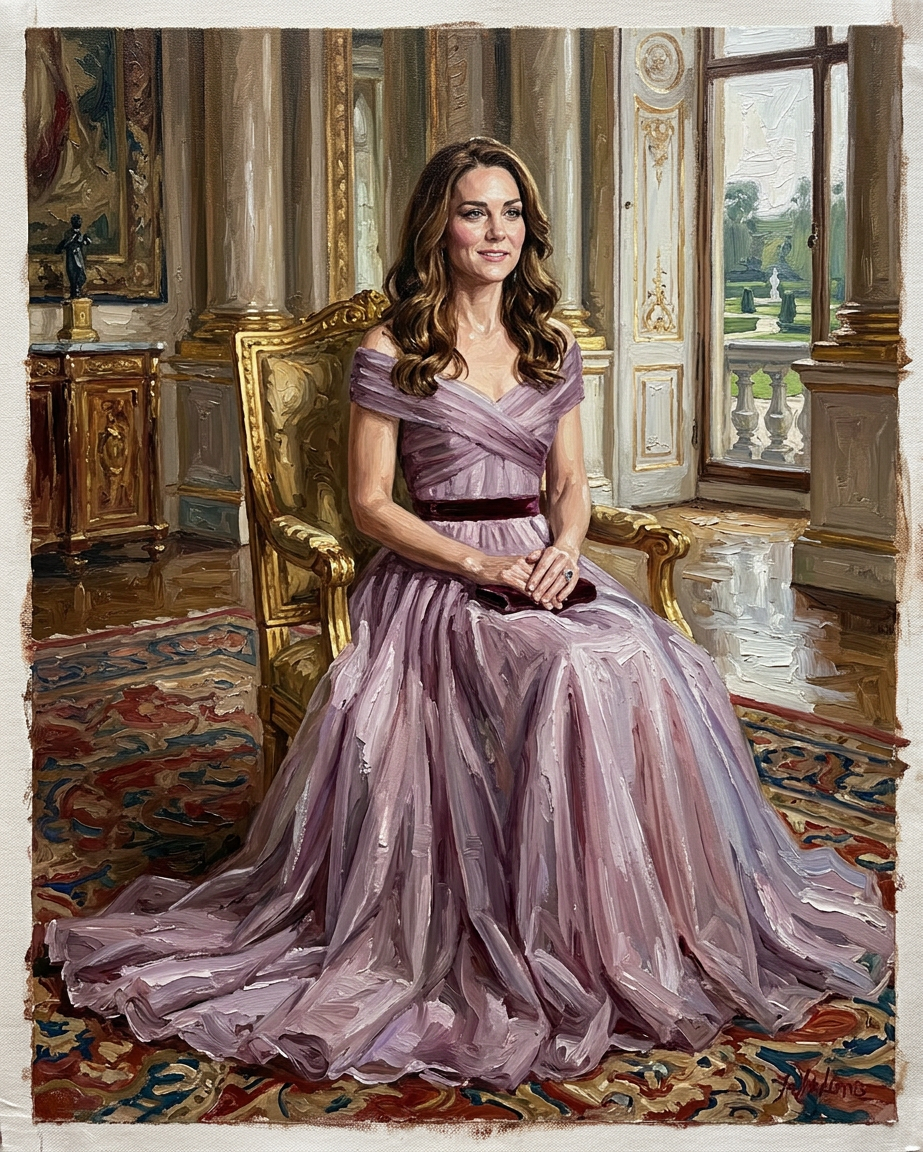
At the 2026 BAFTAs, the Princess of Wales appeared in a lilac chiffon gown she first wore seven years ago. The fashion world called it elegant. Vivienne St. Claire calls it something more interesting than that.
Let us begin with what everyone noticed.
At the 2026 BAFTAs, the Princess of Wales arrived in a lilac chiffon Gucci gown — ethereal, perfectly pitched, the precise shade of someone who understands that a princess at a film awards ceremony should illuminate the room without threatening to outshine it. The dress was exquisite. The photographers were delighted. The fashion press reached immediately for words like radiant and poised.
All correct. All rather missing the point.
Because here is what those of us who track royal wardrobes with the dedication that others reserve for stock portfolios immediately understood: the Princess of Wales had worn that Gucci dress before. To a Women in Finance dinner. In 2019.
Seven years ago. A different chapter of her life entirely. Before a cancer diagnosis. Before the world learned what she was made of.
She wore it again. Deliberately. And that choice tells you everything.
A Royal Never Gets Dressed by Accident
I have spent twenty years cataloguing the wardrobe decisions of queens and princesses across four continents, and I can tell you with absolute certainty: at this level, nothing is accidental. Every hemline is considered. Every colour carries a conversation. Every repeat wearing is a statement.
The question is always: what is the statement?
The Princess of Wales lost her long-time style confidante Natasha Archer in 2025, and observers noted a definite shift in her wardrobe choices — more authoritative looks, more custom pieces for standout events, a capsule wardrobe philosophy built around sustainability and repetition.
Sustainability in royal fashion is not new. The late Queen Elizabeth II wore the same outfits for decades — a fact that was treated, during her lifetime, as endearing frugality and, in retrospect, looks increasingly like visionary restraint. But what the Princess of Wales is doing is something more nuanced than frugality. It is curation. It is the construction of a visual identity that says: I know who I am. I do not need to prove it with something new.
That is a confident woman’s wardrobe. And confidence, in a princess, is always political.
The Lilac Question
Lilac is a colour the Princess of Wales rarely wears. Its appearance at the BAFTAs — and again at a Buckingham Palace reception marking what would have been Queen Elizabeth II’s 100th birthday — suggests something deliberate is happening in her colour palette.
Lilac sits at the intersection of pink and purple. It is softer than the authority of navy or the statement of red. It is warmer than the precision of white. In the language of royal colour — and yes, there is such a language, spoken fluently by every queen who has ever dressed for public life — lilac says: I am approachable. I am feminine. I am not here to dominate.
At the BAFTAs, surrounded by the genuine stars of film and television, that message was exactly right. She deployed what one observer called princess mode — present, luminous, careful not to detract attention from the actors being celebrated. The Gucci gown served that intention perfectly. It was old enough to feel considered rather than competitive. It was beautiful enough to photograph magnificently. It was recycled enough to make a quiet point about what a modern princess values.
The Kate Effect, Evolved
The phenomenon known as the Kate effect — whereby the Princess wearing a particular brand drives visibility and sales, particularly for smaller British houses — has been a constant since her engagement to Prince William in 2010.
But the Kate effect is evolving. In its early incarnation it was about discovery: the Princess wears an unknown label; the label sells out overnight; a designer’s career changes. In its current form it is about something more complex. When she repeats a seven year old Gucci gown at one of Britain’s most photographed evenings, the message to the fashion industry is pointed: buy less. Choose well. Keep the pieces that matter.
That is not a small thing to say from a BAFTA red carpet.
She has repeated a vast array of outfits, sporting a capsule wardrobe philosophy and saving her newest, bespoke pieces for standout events like banquets and award ceremonies. The result is a wardrobe that feels intentional rather than abundant. Considered rather than consumed.
In an industry built on newness, a princess choosing oldness is genuinely radical.
What She Is Building
I watch wardrobes the way historians watch speeches. Individually, each outfit is an event. Collectively, they are a narrative.
The narrative the Princess of Wales is building in 2026 is one of quiet authority. She is not dressing to surprise. She is not dressing to provoke. She is dressing to endure — to construct a visual identity so coherent and so considered that it will still make sense in another seven years, when she might wear that Gucci gown again.
A royal never gets dressed by accident.
This one is dressing for history.
Vivienne St. Claire is Crown & Court’s Fashion & Style Correspondent. A former fashion editor, she has spent two decades cataloguing every brooch, hemline, and colour choice made by queens and princesses worldwide.
“A royal never gets dressed by accident.”