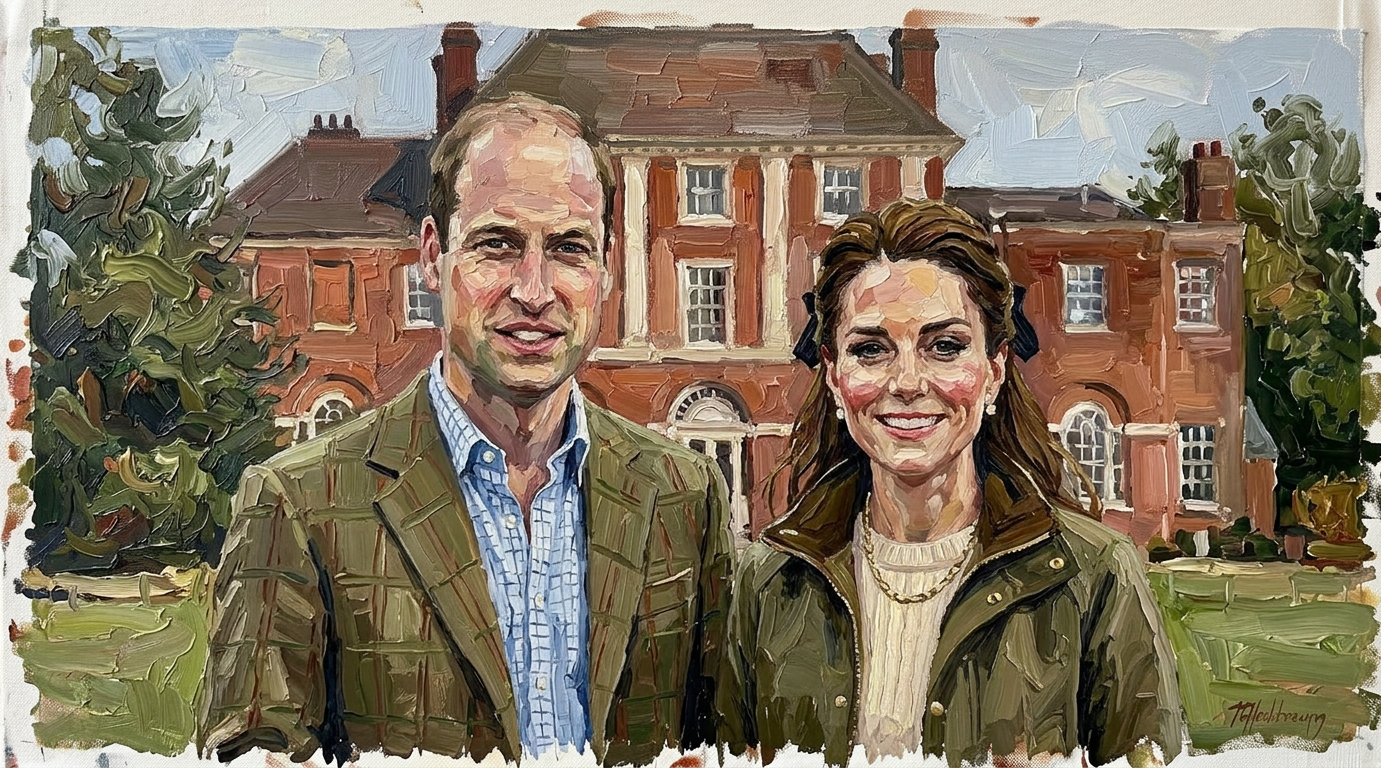
In November 2025, the Prince and Princess of Wales quietly moved their family to a new home in Windsor Great Park. Charlotte Ashby on what happens when the future king chooses somewhere that feels like home.
There is something rather wonderful about the idea of a future king going house hunting.
Not the ceremonial kind of moving — the state apartments and the official residences that come with the job, grand and draughty and hung with portraits of ancestors who did not look particularly comfortable either. I mean the real kind. The standing-in-a-room-imagining-your-children’s-bedrooms kind. The deciding-where-the-dog-will-sleep kind.
In November 2025, the Prince and Princess of Wales relocated from Adelaide Cottage and their residence at Kensington Palace to Forest Lodge, an estate within Windsor Great Park. It was a quiet move, handled with the minimum of fuss, announced months in advance and executed without drama. Very much in the style of the couple who made it.
And yet for those of us who find the domestic lives of royal families endlessly fascinating — which is to say, for those of us who understand that the private always illuminates the public — this move is rich with meaning.
Why Windsor?
Windsor Great Park is not, strictly speaking, the countryside. It is something more particular than that: a vast, ancient landscape sitting at the edge of one of England’s most historic towns, presided over by a castle that has been continuously inhabited by the royal family for nearly a thousand years. It is the kind of place where you might take an evening walk and find yourself thinking about history without particularly meaning to.
For the Wales family, Windsor already means something. Windsor Castle is a working royal residence, its grounds familiar territory for a family that has spent considerable time there in recent years. Moving to Forest Lodge keeps them within that orbit — close enough to the castle for the working requirements of royal life, set within grounds large enough for three children to run freely.
That last detail matters more than it might seem. George, Charlotte, and Louis — eleven, ten, and seven at the time of the move — are at precisely the age when space and freedom and somewhere to properly play are not luxuries but necessities. A future king is still, first and always, a father. The house he chooses for his children tells you something true about him.
The Adelaide Cottage Chapter
To understand Forest Lodge, it helps to understand what came before it.
Adelaide Cottage, the Wales family’s previous home on the Windsor estate, was chosen in 2022 for its relative modesty. Four bedrooms. No live-in staff. A deliberate signal that the Prince and Princess of Wales were committed to raising their children with something resembling ordinary family life — school runs and homework and weekends that belonged to them rather than to the institution.
That philosophy hasn’t changed. What has changed is that three children in four bedrooms, with a royal schedule of ever-increasing complexity and a household that requires proper space to function, had simply outgrown their cottage.
Forest Lodge represents the natural next chapter: larger, more suitable for a growing family and its working requirements, still within the landscape that the family clearly loves. It is an upgrade born of necessity rather than ambition, which is rather a nice thing to be able to say about the future king’s choice of home.
What Home Means to This Family
I have spent considerable time thinking about what the concept of home means to the royal family — not the official residences, the palaces and the castles that belong to the Crown rather than to the people who inhabit them, but the places that are genuinely, personally theirs.
Highgrove House, the Georgian manor that King Charles transformed over decades into fifteen acres of extraordinary gardens, tells you everything about who Charles is — a man who puts down roots, who tends things carefully, who believes that a home should be cultivated rather than simply occupied.
His son appears to share that instinct. The choice of Windsor — staying within a landscape already meaningful to the family rather than striking out somewhere entirely new — suggests a man who values continuity. Who wants his children to grow up knowing a place deeply rather than moving through many places lightly.
There is something in that which feels quietly important for the future of the monarchy. Institutions that endure are institutions with roots. A king who understands that home matters — really matters, not ceremonially but genuinely — is a king who might understand why it matters to everyone else too.
The Children’s Windsor
Here is what I find most charming about the Wales family’s Windsor chapter: the children are growing up in one of the most historically extraordinary landscapes in England and, by all accounts, treating it exactly as children should treat any landscape.
They ride. They explore. They attend the local school. Princess Charlotte, by various reports, has become a confident and independent character; Prince George is serious and thoughtful; Prince Louis is, by the account of every public appearance, absolutely irrepressible.
They are, in other words, children. Growing up in a remarkable place but experiencing it, one hopes, as simply their home. The place where they know which path goes where. The place that will live in their memories long after they have moved on to whatever extraordinary lives await them.
Behind every crown is a family. And families, as I have always maintained, are always interesting.
This one is no exception.
Charlotte Ashby is Crown & Court’s Culture & Lifestyle Editor. A country house enthusiast and royal devotee, she writes about the homes, the rituals, and the family moments behind the royal pageantry.
“Behind every crown is a family — and families are always interesting.”