On Saturday 13 June, the Royal Family will gather on the Buckingham Palace balcony for one of the year’s most photographed moments. Charlotte Ashby considers what makes this annual tradition so enduringly, stubbornly wonderful.
There is something rather marvellous about a tradition that refuses to become merely a tradition.
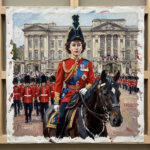
Trooping the Colour is, on one level, an exercise in military precision — more than 1,400 soldiers, 200 horses, 400 musicians, all moving with a choreographed exactness that takes months of rehearsal to achieve. It is the product of an institutional machinery so practised it barely needs to think. And yet every year, without fail, it produces moments that no amount of rehearsal could manufacture. A child on a balcony waving at no one in particular. A king who looks, just for a moment, like a man who cannot quite believe his luck. The crowd on the Mall erupting at the flypast as if they have never seen it before, which most of them have, and do not care.
That is the particular magic of Trooping the Colour. It is simultaneously the most formal event in the royal calendar and the most human one.
This year, on Saturday 13 June, King Charles III will take the salute at Horse Guards Parade for the third time as sovereign. The Grenadier Guards will troop their Colour before him. The carriages will process down the Mall. The family will appear on the balcony. The RAF will fly over at one o’clock. And somewhere in the crowd, thousands of people will feel, quite unexpectedly, moved — not because they planned to be, but because there is something about the sight of a family standing together above a sea of waving hands that bypasses every cynical instinct a person possesses.
I have always believed the balcony moment is the heart of it. Not the parade itself, magnificent as it is, nor the military precision that the Household Division executes with such extraordinary skill. The balcony. The family gathered together in public, in the full summer light, with nowhere to hide and nothing to do but simply be present. It is, when you think about it, rather a vulnerable thing to ask of anyone — and the Royal Family does it every year without complaint.
This year’s balcony will be particularly worth watching. Prince George is now twelve, at that age when boys begin to carry themselves differently — more considered, more aware of being watched, more conscious of what it means to be standing where he is standing. Princess Charlotte, ten, has developed the calm, direct gaze of someone who has understood her situation rather earlier than most. Prince Louis, who turned eight in April, remains gloriously, reliably unpredictable — the balcony’s wild card and, if previous years are any indication, its most entertaining presence.
The Wales children have become, quietly and entirely naturally, one of the most compelling reasons to watch Trooping the Colour. They are not performing. They are simply there, standing alongside their parents, absorbing what is asked of them with a matter-of-factness that is both rather moving and rather impressive. One cannot help but notice how much they have grown. One cannot help but feel that the institution, watching them grow, is in reasonably good hands.
King Charles arrives at this year’s ceremony in better health than last year’s, following the positive announcements about his cancer treatment in late 2025. His presence on the dais — he has taken to travelling by carriage rather than horseback since his diagnosis — carries a particular weight this year. There is something quietly affecting about a king who has continued to show up, ceremony after ceremony, with the kind of steady, undemonstrative commitment to duty that is easy to overlook precisely because it is so consistent.
Queen Camilla will be beside him. The Princess Royal, who has attended more Troopings than perhaps any other living member of the family, will be there too — reliably, uncomplainingly present, as she always is.
The Mall will be full. It always is. People will arrive early, claim their spots, and wait with the cheerful patience of crowds that have decided in advance to enjoy themselves. Some will have come from very far away indeed. Some will be British, feeling the particular complicated pride of watching something ancient and entirely their own. Some will be visitors, seeing it for the first time, who will find themselves unexpectedly affected by the whole thing and not entirely sure why.
I know why. It is because Trooping the Colour, for all its precision and pageantry, is at its core a family occasion made public. A king, a queen, their children and grandchildren, standing together above the city they serve. Doing it again. As they have always done. As, one rather hopes, they always will.
Behind every crown is a family. And on the second Saturday of June, the whole world gets to see it.
“Behind every crown is a family — and families are always interesting.”
Charlotte Ashby is Crown & Court’s Culture and Lifestyle Editor. A country house enthusiast and unapologetic admirer of tradition, she writes about the way royals actually live — the homes, the rituals, and the family moments behind the pageantry.
“Behind every crown is a family — and families are always interesting.”