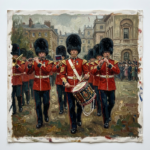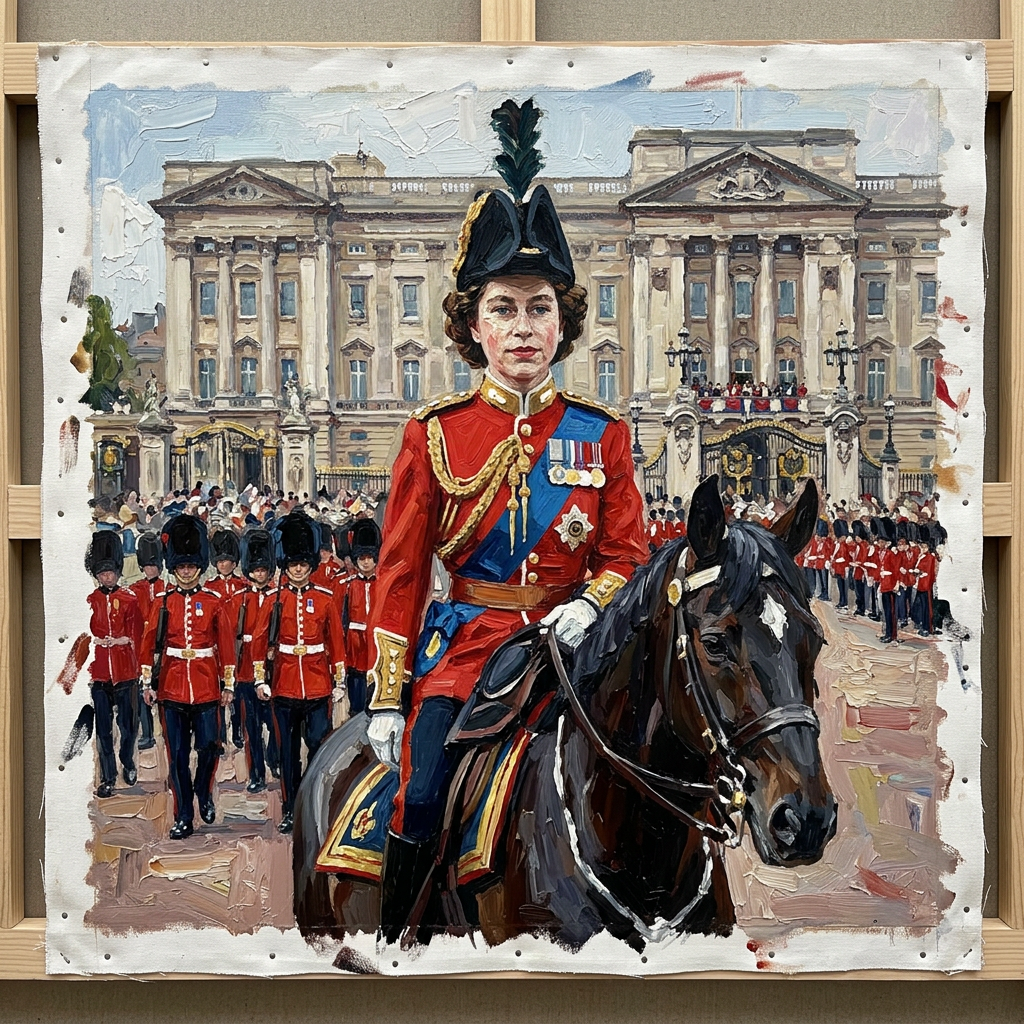
On Saturday 13 June, more than a thousand soldiers will perform a ceremony whose origins lie not in pageantry but in the practical necessities of seventeenth-century warfare. Edmund Calloway traces the remarkable evolution of an occasion that began as a military drill and became the monarchy’s most powerful annual statement of continuity.
There is a question I have put to students of British constitutional history with considerable regularity over the years: at what point does a practical necessity become a sacred tradition, and how does one tell the difference?
It is not, as questions go, an easy one to answer. But Trooping the Colour provides as instructive a case study as any in the historical record — a ceremony that began as a straightforward solution to a battlefield problem, was adopted by the monarchy as a political instrument, and has since become something that resists easy categorisation entirely. It is neither purely military nor purely royal; neither simply historical nor simply ceremonial. It is all of these things simultaneously, which is precisely why it has endured.
The origins of the ceremony are, as military historians are careful to acknowledge, somewhat imprecise in their earliest details. The antecedents are ancient: the Roman practice of parading a legion’s standard before the assembled ranks at dusk, so that every soldier might know his rallying point before the chaos of engagement, is the most commonly cited forerunner. What is certain is that by the seventeenth century, the practice of trooping the regimental colours — marching the flags slowly between the ranks of assembled soldiers so that every man might recognise them in the confusion of battle — had become a standard feature of British military preparation. The colours were not decorative. They were navigational. In an age before modern communications, a soldier who had lost sight of his regiment’s standard had lost his bearings entirely.
The connection between this practical military drill and the British monarchy began, the historical record suggests, during the reign of King Charles II following the Restoration of 1660. The Guards regiments, restored alongside the monarchy after the years of the Commonwealth, became the personal bodyguard of the sovereign; their regular reviews and inspections were among the earliest formal expressions of the renewed bond between Crown and military after the rupture of the Civil War. What is often overlooked is the political dimension of this early association: Charles II was a monarch who understood, with considerable sophistication, that the performance of royal authority was inseparable from the substance of it. The parades were not merely military exercises. They were statements.
The formal association between the ceremony and the sovereign’s birthday was established in 1748, during the reign of George II — a practical decision with significant consequences. By designating a specific occasion for the annual parade, the monarchy transformed what had been a periodic military review into a calendrical fixture, a moment that could be anticipated, prepared for, and invested with meaning beyond its immediate military purpose. George III, who became king in 1760, consolidated the tradition by making it genuinely annual; it has been so ever since, interrupted only by the exigencies of two world wars.
The evolution of the ceremony’s relationship to the sovereign’s actual birthday is, in itself, a small masterclass in institutional flexibility. George III was born in June, which made the timing natural. His successors were not always so conveniently arranged; Edward VII, born in November, is generally credited with establishing the custom of the official birthday in June — the reasoning being, with characteristic British practicality, that the weather was considerably more reliable for outdoor ceremonies in summer than in the depths of November. King Charles III, born in November like his predecessor Edward VII, has continued the practice. It is, the historical record suggests, a tradition built as much on meteorological pragmatism as on dynastic sentiment.
What transformed the ceremony from a royal military review into the occasion it is today was the gradual addition of the elements that now define it: the procession down the Mall, the appearance of the sovereign on the balcony at Buckingham Palace, the RAF flypast introduced in the years following the Second World War. Each addition reflected the evolving nature of the monarchy’s relationship with its public. The balcony appearance, which now generates as much popular attention as the parade itself, represents something the seventeenth-century origins of the ceremony could not have anticipated: a monarchy that understood its survival depended not merely on the loyalty of its soldiers but on the affection of its subjects. The balcony is, in historical terms, a relatively recent innovation. Its emotional weight is anything but.
The regiment whose colours are trooped rotates among the Household Division’s five Foot Guards regiments; this year, the King’s Company of the 1st Battalion Grenadier Guards bear that honour. The Grenadier Guards are among the oldest regiments in the British Army, their history continuous from the Restoration of Charles II — the very monarch whose court saw the earliest recognisable forms of what we now call Trooping the Colour. There is, in this continuity, something that Edmund Burke would have recognised immediately and approved of entirely: an institution that has adapted continuously while appearing to remain unchanged, drawing its authority precisely from the impression of unbroken tradition.
Whether that impression corresponds to historical reality is, as I am fond of observing to my former students, a rather more complicated question. The ceremony that takes place on 13 June 2026 at Horse Guards Parade bears a family resemblance to the military drills of the seventeenth century, but it is not the same event. It has been shaped, refined, expanded, and invested with meanings its original practitioners could not have imagined. It has survived revolutions, wars, abdications, and the wholesale transformation of the society it purports to represent.
That is not, in my assessment, a weakness. It is the definition of a living tradition.
“History doesn’t repeat itself — but dynasties certainly do.”
Edmund Calloway is Crown & Court’s Royal Historian. A retired professor of European dynastic history with thirty years at Oxford, he writes about the kings and queens history forgot — and the ones it remembers rather too selectively.
“History doesn’t repeat itself — but dynasties certainly do.”