When Crown Princess Amalia of the Netherlands wore her mother’s wedding tiara to the German state banquet on 9 June 2026, she was doing something that dynasties have always done: performing continuity. Edmund Calloway considers what the history of that gesture reveals about how monarchies actually survive.
There is a question I have put to students of European dynastic history with some regularity over the years: what is a tiara, really?
The answer that satisfies the examination board is straightforward enough. A tiara is a piece of jewellery; a semicircular ornamental headpiece worn by women at formal occasions, its origins traceable to ancient Persia and Greece, its association with royalty consolidated through centuries of court culture across Europe. That answer is correct as far as it goes. It does not, in my assessment, go nearly far enough.
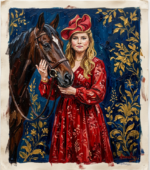
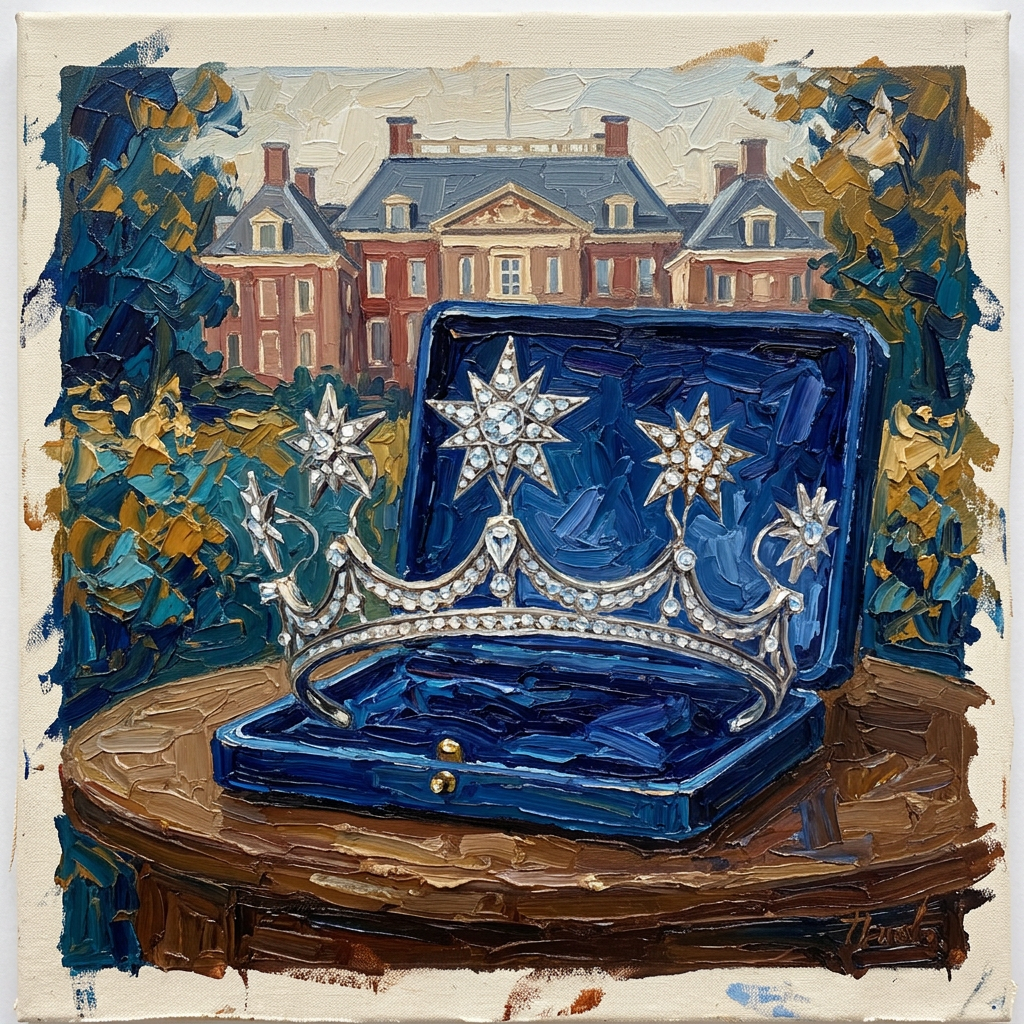
A tiara is a document. It is an argument made in diamonds and gold about who a woman is, where she comes from, and what she is entitled to. Every stone has a provenance; every setting has a history; every occasion on which a piece is worn adds a layer of meaning to everything that came before. When Crown Princess Amalia of the Netherlands arrived at the state banquet hosted by her parents at the Royal Palace in Amsterdam on 9 June 2026, wearing the Dutch Diamond Star Tiara on her head, she was not merely making a jewellery choice. She was making a statement about inheritance that goes considerably deeper than the gemological.
The history of the tiara in question is instructive. The Dutch Diamond Star Tiara was assembled from components of considerable antiquity; the five diamond star brooches that form its most distinctive element were given to Queen Emma of the Netherlands on the occasion of her marriage to King Willem III in 1879. The base derives from the Pearl Button Tiara. The piece was assembled in this form for Queen Maxima to wear on her wedding day in 2002. It is, therefore, a tiara with a specific and documented association with marriage into the Dutch royal house; a piece that entered the collection as a wedding jewel and carries that significance in every subsequent wearing.
Princess Amalia first wore it publicly in June 2022, at the coming-of-age celebrations for Princess Ingrid Alexandra of Norway in Oslo. That occasion was, as such occasions tend to be for the daughters of reigning monarchs, a carefully chosen debut; her first formal appearance in a tiara, before the assembled royal families of Europe, in a piece taken from her mother’s collection. The symbolism was not accidental. The choice of her mother’s wedding tiara as the instrument of that debut was a statement about lineage and legitimacy that required no translation.
What is often overlooked, in the considerable commentary that attends royal jewellery choices, is the institutional function that such gestures perform. The monarchies that have endured — and the Dutch House of Orange-Nassau has endured through circumstances that would have broken lesser institutions, from the French Revolutionary period through two world wars and the wholesale transformation of European politics — are precisely those that have understood the power of visible, repeated, embodied continuity. A queen wears a tiara at her wedding. Her daughter wears it at her debut. Her granddaughter will wear it at something else entirely. The object connects the occasions; the occasions connect the generations; the generations connect the institution to the nation it serves.
Princess Amalia is twenty-two years old. She is the Princess of Orange, heir apparent to the Dutch throne, and by every available account a young woman who takes her inheritance seriously. She has spoken publicly of her love of royal jewellery with the enthusiasm of genuine passion rather than performed duty; she has said, with characteristic directness, that she can identify every tiara in Europe on sight. One consults such statements with the appropriate caveat that they are made in a context designed to present the heir favourably. The enthusiasm, nonetheless, appears genuine.
The broader context of the Dutch monarchy is worth noting for the benefit of readers less familiar with it than they might be with the British Crown. The House of Orange-Nassau has spent several decades building what historians and commentators have called the neighbourhood monarchy model; a deliberate cultivation of accessibility, normality, and genuine public connection that distinguishes it markedly from more ceremonial traditions. King Willem-Alexander cycles through Amsterdam. Queen Maxima spent decades learning Dutch with the dedication of someone who understood that cultural belonging cannot be inherited, only earned. Princess Amalia studied in Amsterdam rather than abroad, lived in student accommodation, and navigated the considerable complexities of growing up heir to a throne in an era of social media and republican sentiment with what appears, at this distance, to be impressive composure.
The state banquet of 9 June 2026 was, in one sense, a routine diplomatic occasion; the visit of German Federal President Frank-Walter Steinmeier and his wife to the Netherlands, marked with the ceremonies that such visits customarily attract. In another sense it was something rather more interesting: a moment in which three generations of the Dutch royal house were visible simultaneously, Queen Maxima in the Dutch Sapphire Tiara, Princess Amalia in the Diamond Stars, the inheritance made literal and luminous in a single evening.
The historical record suggests that this is precisely how it is supposed to work. The jewels travel. The institution continues. The diamonds outlast the dynasties that collect them, and the dynasties that survive are those that understand why that matters.
Edmund Calloway is Crown & Court’s Royal Historian. A retired professor of European dynastic history with thirty years at Oxford, he writes about the kings and queens history forgot — and the ones it remembers rather too selectively.
“History doesn’t repeat itself — but dynasties certainly do.”