Crown & Court participates in the Amazon Associates programme and may earn commission from qualifying purchases made through links in this article.
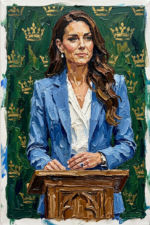
At a state banquet, on a foreign tarmac, on a summer balcony, the Princess of Wales has learned to say things she never speaks aloud. The garment carries the message.
The green was not a decoration. The green was a sentence.
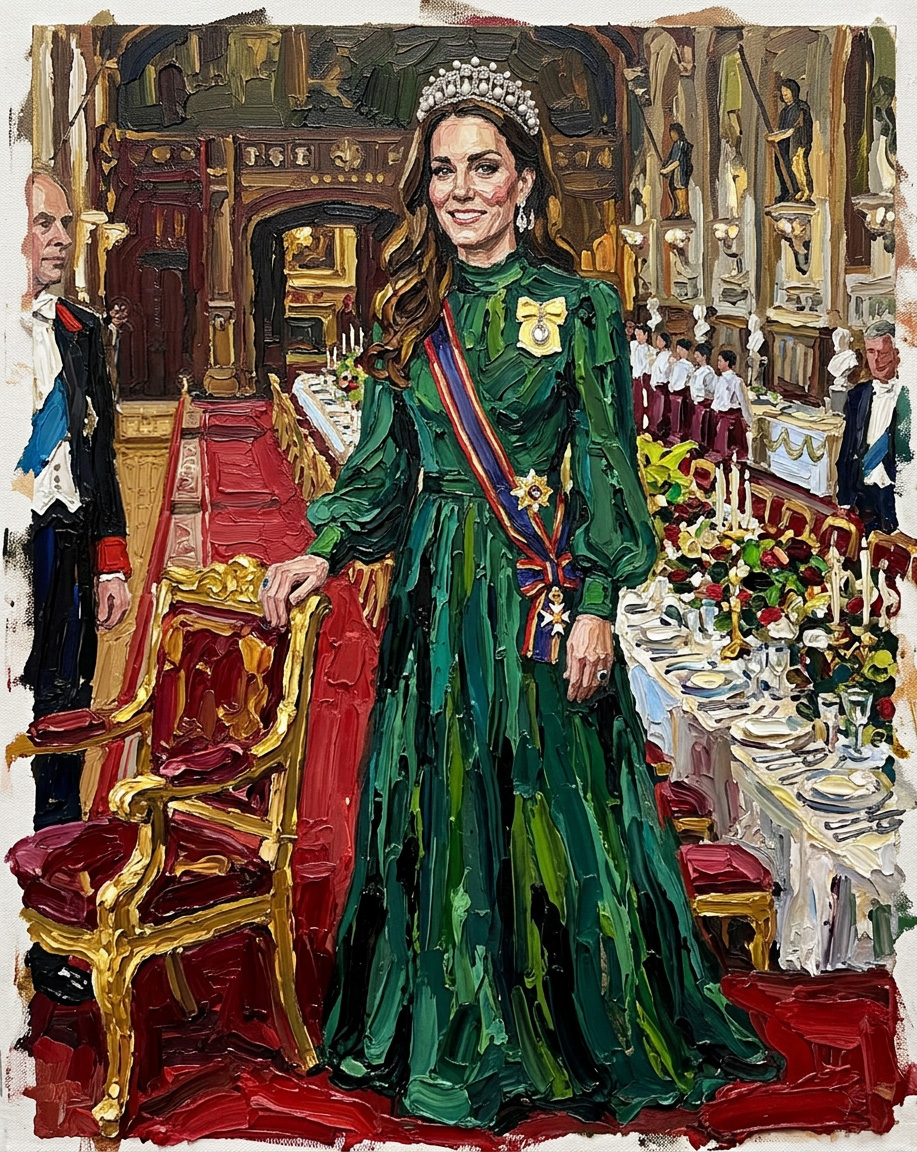
March 2026. A state banquet at Windsor Castle in honour of Nigeria. The Princess of Wales arrives in a floor length emerald gown by Andrew Gn, green Manolo Blahnik heels beneath it, the shade lifted straight from the Nigerian flag. Nobody in the room needed the reference explained. That is the entire point.
This is flag dressing. And Catherine has turned it into her own quiet dialect.
The method is never literal. She does not arrive draped in a foreign flag like a football supporter. She takes one colour, occasionally two, and lets the tailoring do the diplomacy. Restraint is the whole trick. Speaking to Hello!, British designer Amanda Wakeley described the approach as a measured way of signalling respect without ever tipping into anything overt. Precisely pitched. That is the register Catherine works in, and she has worked in it for fifteen years.
Consider the archive.
Canada, 2011. Her first overseas tour as a married woman. Canada Day in Ottawa, and she steps out in white beneath a red hat trimmed with fabric maple leaves. The national palette, exactly. Then the detail that separates the amateur from the fluent. Pinned to her, the maple leaf brooch that Queen Elizabeth II first wore on her own Canadian tour in 1951. One piece of jewellery. Two messages. Respect for the host nation, and a bow to the woman who wore the crown before her. Nothing about it was accidental.
Poland, 2017. She lands in Warsaw in a crisp white Alexander McQueen coat, a bold red clutch in her hand. White and red. The Polish flag, rendered as tailoring.
Ireland, 2020. A deep green Catherine Walker coat. Shamrock earrings by Daniella Draper. A country, read back to itself in cut and colour.
Then the grander rooms. The French state banquet of 2025 brought a red Sarah Burton for Givenchy gown. Note the discipline there. She took a single colour from the tricolore rather than all three. A whole flag would have been costume. One shade was a compliment.
And the flag is only half of the grammar. She dresses the host nation’s ateliers too. In Warsaw she wore a local designer, Gosia Baczynska, to a garden party. Across that first Canadian tour she moved through Canadian labels, a Smythe blazer, an Erdem gown. The colour honours the country. The label honours its industry. Two courtesies, folded into one appearance. This is the part the casual observers miss entirely.
What lifts all of this above a party trick is the consistency. She grasped early what most public figures never do. The camera reads colour before it reads a face. A woman on a global stage composes a sentence every time she settles on a hemline. The silhouette speaks first, and hers is rarely saying nothing.
The vocabulary is not only national. It is dynastic. That emerald Nigerian gown was finished with the Lovers Knot tiara, once Diana’s, and the Queen Mother’s sapphire earrings. A foreign flag and a family history, worn in the same breath. Two conversations at once, and both entirely intentional.
The same instinct shows up even when there is no flag to honour. It was there at Trooping the Colour this June, when every shade on that balcony was chosen to sit correctly beside the family around her. It was there again at her return to Royal Ascot, where the message was continuity rather than nationhood. The fluency does not switch off at the British border. It simply changes subject.
Which is precisely why the amateurs misread her. They call the look pretty and move on. They miss that she is writing.
So watch the palette. Watch the brooch. Watch which single colour she borrows from a flag, and which she deliberately leaves behind. The Princess of Wales is not decorating herself. She is speaking, in a language most of us were never taught to read, and she has become entirely fluent in it. If you want the grammar behind it, the way a garment has carried meaning across centuries of court dressing, How to Read a Dress by Lydia Edwards is required reading, frankly. Learn it, and the flag dressing stops looking like fashion. It starts looking like what it is. Diplomacy, cut and sewn.
A royal never gets dressed by accident. This one is dressing in full sentences.
Vivienne St. Claire is Crown & Court’s Fashion and Style Correspondent. A former fashion editor with twenty years spent cataloguing royal wardrobes around the world, she reads a hemline the way others read a headline.
“A royal never gets dressed by accident.”