Crown Chronicles: history that still shapes the throne.
There is something I find rather extraordinary about an object so sacred that the man who legally owns it is not permitted to look at it. That is, as far as anyone outside the Imperial Household Agency can tell, the actual situation with Japan’s Three Sacred Treasures.
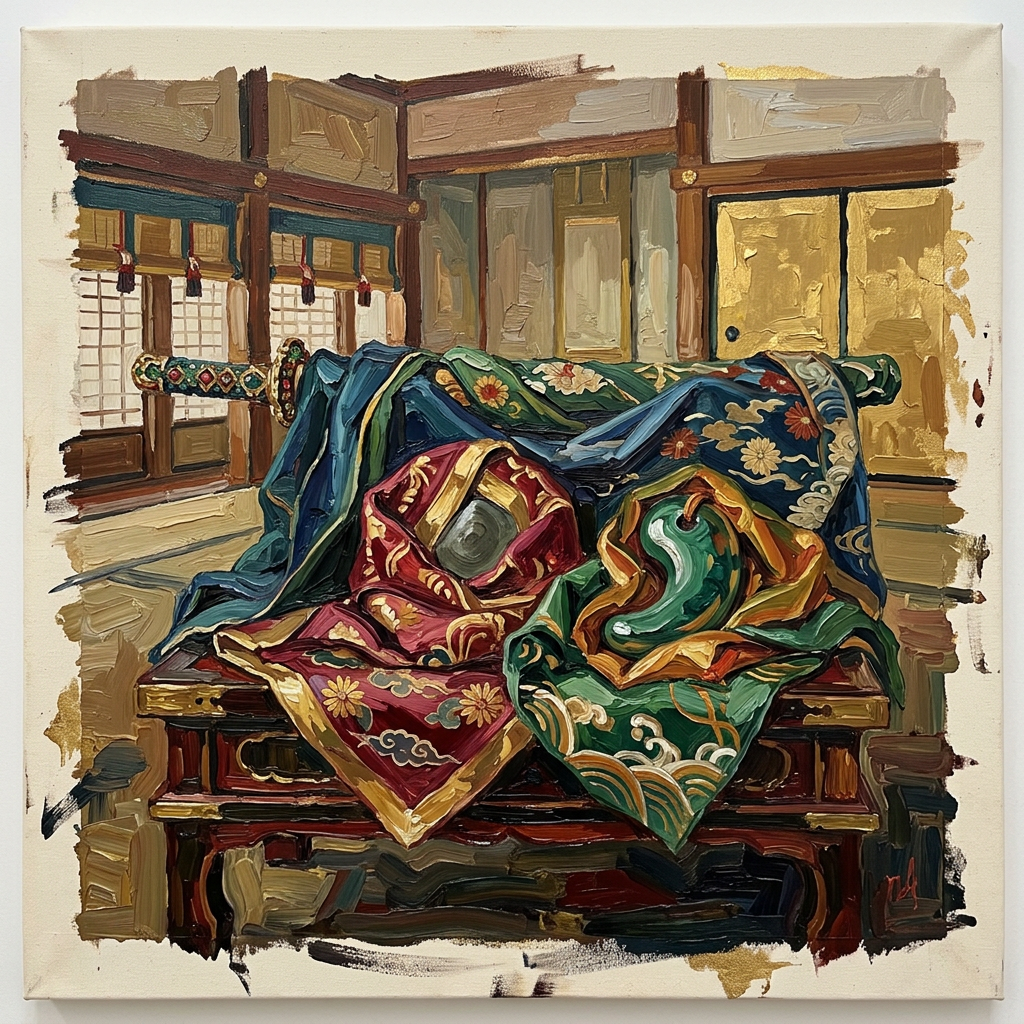
The regalia consists of a mirror, a sword, and a jewel. The mirror is called Yata no Kagami and stands for wisdom. The sword is Kusanagi no Tsurugi, valour. The jewel is Yasakani no Magatama, benevolence. According to Shinto tradition, all three were given by the sun goddess Amaterasu to her grandson as he descended to bring order to Japan, and they have passed from sovereign to sovereign ever since. Since the year 690, presenting them to a new emperor has been a central part of the enthronement ceremony. I rather love that detail. Thirteen centuries of doing the same thing, the same way, and nobody has ever thought to modernise it.
Here is the part that I find genuinely interesting. Nobody, including the emperor himself, is allowed to see the treasures unwrapped. When Emperor Naruhito formally took possession of the regalia on 1 May 2019, the sword and the jewel were carried in by senior chamberlains inside wooden boxes, still wrapped, exactly as they had been for his father and his father’s father. The mirror did not even make the trip. It stays at Ise Grand Shrine, considered far too sacred to move. So the treasures that legitimise an entire imperial line have never actually been confirmed to exist by anyone who isn’t already inside the institution. One historian I came across called the secrecy itself a source of authority, and I think he is exactly right. Mystery, kept carefully enough, becomes its own kind of proof.
I find I cannot decide whether this is the most impractical system of royal inheritance I have ever encountered, or the most quietly brilliant one. Every other monarchy I write about eventually puts its crown jewels in a museum case for tourists to photograph. Japan has spent thirteen hundred years doing the opposite, and the position of the Chrysanthemum Throne has never once been seriously questioned on the grounds that nobody can verify what’s in the box. There is a lesson in there about tradition, though I am still deciding exactly what it is.
What I keep returning to is how the ceremony works without spectacle. No crown is lowered onto a head. No orb is held aloft for the cameras. A box changes hands, wrapped in cloth, carried by men whose job has existed for longer than most countries have. It is enthronement conducted almost entirely on trust. If you wanted proof that ritual can carry more weight than display, you would struggle to find a better example than this one. The current succession question facing the Chrysanthemum Throne, which I know Edmund has written about in real depth, only makes the treasures feel more significant rather than less. A monarchy that may run short of heirs is, if anything, more attached to the objects that say it has always continued, regardless of who happens to be holding them.
Behind every crown is a family. And in this particular case, behind every box is a faith that none of us, including the family wearing the crown, gets to fully examine.
Charlotte Ashby is Crown & Court’s Culture & Lifestyle Correspondent. A country house enthusiast and lifelong royal devotee, she writes about how royals actually live, the homes, the rituals, the family moments that rarely make headlines.
“Behind every crown is a family. And families are always interesting.”