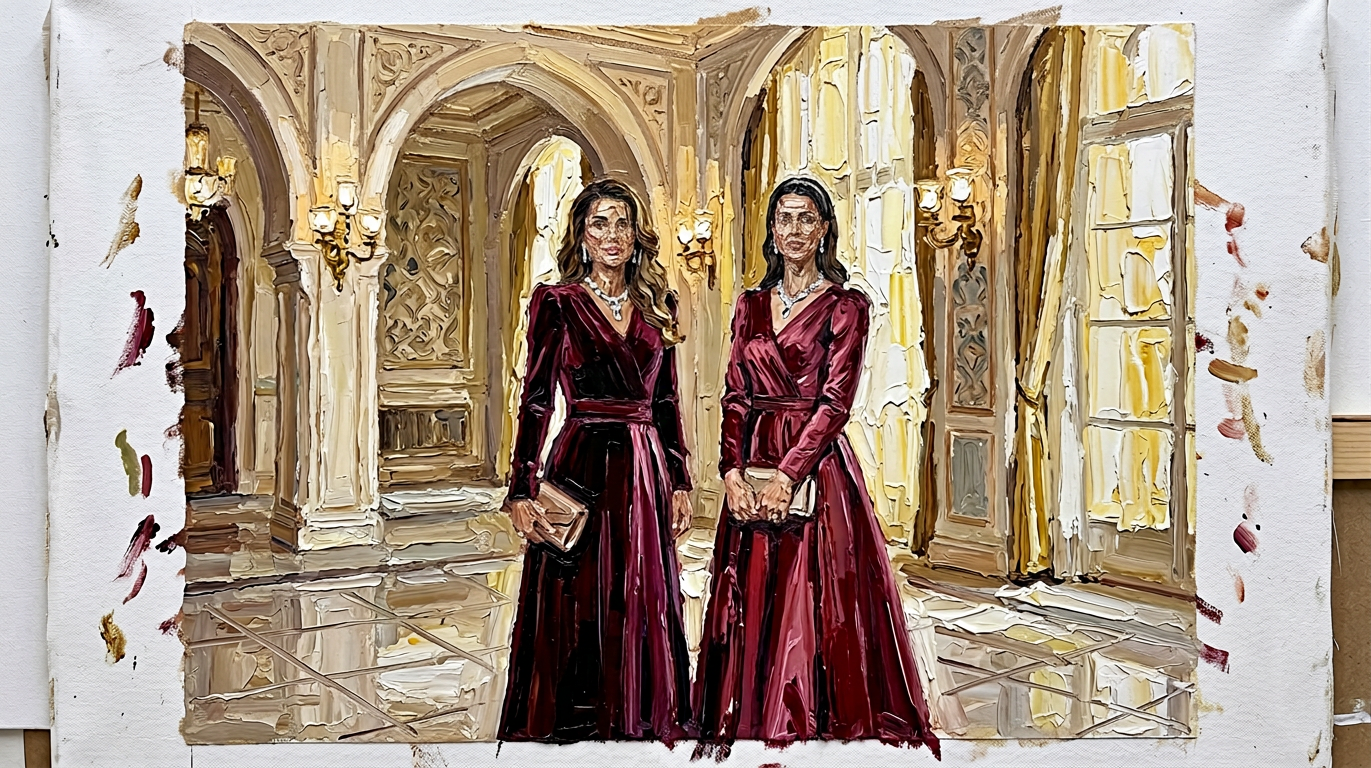
Jordan’s royal women have quietly become the most consistently interesting wardrobe act in global royal circles. One has spent twenty-five years perfecting the art. The other arrived already knowing it.
Let us begin with the Iftar.
In February 2026, the Jordanian royal family gathered at Al Husseiniya Palace in Amman to mark the first evening of Ramadan. Queen Rania wore a red kaftan by Bouguessa. Princess Rajwa wore an embroidered black thobe by Art of Heritage, its bodice and sleeves detailed with traditional Najdi embroidery. Two women. Two generations. Two completely different silhouettes. One entirely coherent message.
That is what sophisticated royal dressing looks like. Not matching. Harmonising.
Queen Rania Al Abdullah has been one of the most studied royal wardrobes in the world for the better part of three decades. Since ascending to the throne alongside King Abdullah II in 1999, she has developed a fashion language of extraordinary range and precision — international couture balanced against regional designers, contemporary silhouettes grounded in cultural reference, every choice calibrated to the audience and occasion with the discipline of someone who understands that a queen’s wardrobe is never purely personal. At Jordan’s 80th Independence Day celebrations in May 2026, she wore a sky-blue Valentino silk shirt dress with blue suede pumps by Jennifer Chamandi and a braided Fendi bag. Sophisticated. International. Unmistakably authoritative.
Nothing about this was accidental.
What makes Rania’s wardrobe genuinely interesting — and what separates her from the merely well-dressed — is the consistency of her cultural intelligence. She wears Valentino to a parliamentary opening and a Bouguessa kaftan to a family Iftar. She wore a Solace London maroon cape dress to Jordan’s 78th Independence Day, anchored with bronze Manolo Blahnik pumps. The through-line is not a designer or a silhouette. It is intention. Every look is pitched precisely — formal where formality is required, regional where regional resonance matters, international where Jordan’s global standing is the point.
Then there is Rajwa.
Princess Rajwa Al Hussein — Saudi-born, married to Crown Prince Hussein in June 2023 — arrived in the Jordanian royal family with a wardrobe already fully formed. She did not need to find her style. She walked in with it. Her aesthetic is architectural. Precise. Quietly modern. At the parliamentary opening in October 2025 she wore a Self-Portrait grey twill midi dress with Saint Laurent slingback pumps and a custom By Sireen bag bearing her daughter Princess Iman’s name in Arabic. The international label, the Jordanian accessory, the personal detail. Considered to the last stitch.
At Windsor Castle, meeting the Princess of Wales, she wore Alexander McQueen. The choice was deliberate. McQueen has a particular weight in British royal circles — it is the house that dressed a future Queen for her wedding. Rajwa wore it to a diplomatic meeting. The fashion world noticed. It always does.
What is emerging between these two women is something rarer than individual style. It is a generational conversation conducted entirely through clothing. Rania established the vocabulary — the balance of international and regional, the diplomatic wardrobe deployed as soft power, the understanding that a royal woman’s appearance is always a statement whether she intends it to be or not. Rajwa has absorbed that vocabulary and begun to speak it in her own register. At the Iftar, commentators noted the subtle chromatic dialogue between Rania’s red kaftan and Rajwa’s embroidered black thobe. Two women dressing independently. Landing in conversation.
In twenty years of watching royal wardrobes, the combinations that endure are not the ones that match. They are the ones that speak to each other across a room — across a generation — with complete understanding and no need for explanation.
Jordan has two of them. The rest of the royal world is only beginning to pay attention.
A royal never gets dressed by accident. In Amman, they never have.
Vivienne St. Claire is Crown & Court’s Fashion & Style Correspondent. A former fashion editor with two decades cataloguing royal wardrobes worldwide, she believes every wardrobe choice is a political act.
“A royal never gets dressed by accident.”